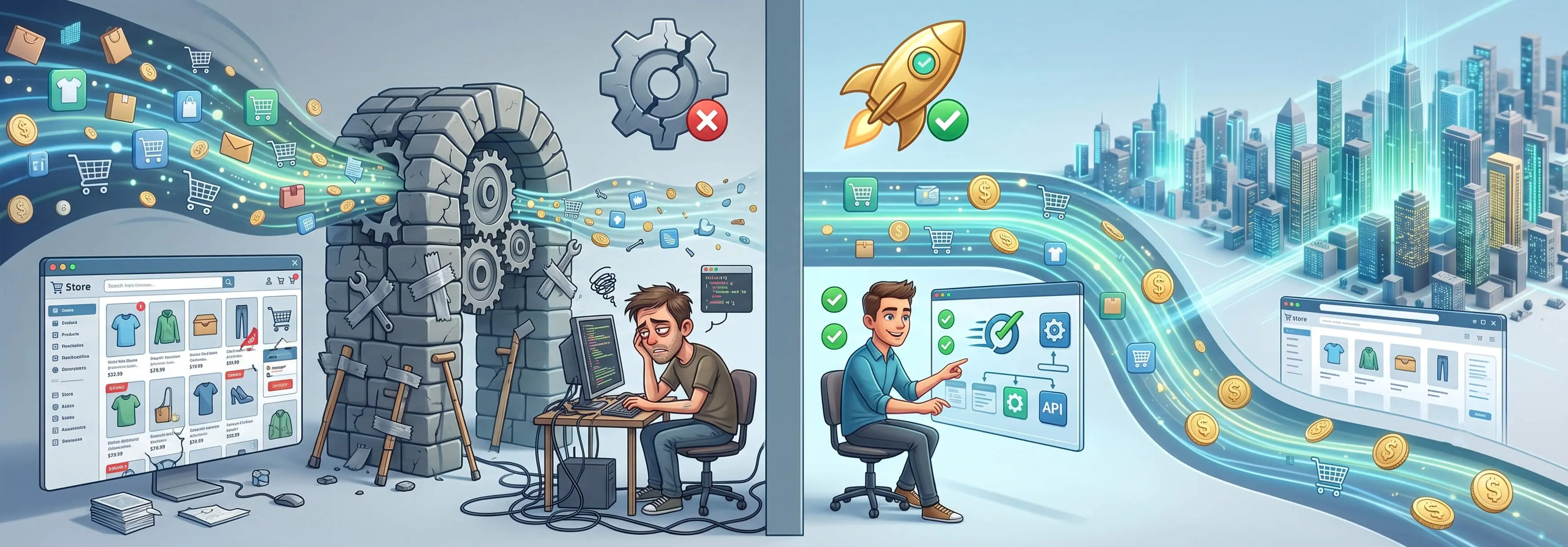
Launching an online store on a ready-made platform, a boxed solution, or a heavy site builder with hundreds of plugins seems like an ideal start. It's relatively fast and cheap: you buy a template, connect a couple of modules for payment and delivery, upload products - and sales begin.
At the startup stage, when the catalog has 100 items and traffic amounts to dozens of people per day, this scheme actually works tolerably. But as soon as the business starts to grow, the «quick solution» turns into an anchor that drags the company down. Instead of development, you get an endless struggle with technical limitations.
Let's break down why an outgrown template-based site starts eating your money and why trying to save on architecture at the beginning leads to multiplied losses in the future.
1. The Glass Ceiling of Performance: Why the Site Can't Be Sped Up
When traffic and database volume grow, a template-based store inevitably starts to slow down. Buyers are not willing to wait 5–7 seconds for a product page to load. The result is abandoned carts, a drop in conversion, and a hit to SEO (since search engines severely penalize slow sites).
You set a task: «We need to urgently increase loading speed». But it turns out that doing this properly is physically impossible:
-
Non-optimal resource loading: The universal template and dozens of connected plugins drag megabytes of unused code, heavy scripts, and redundant styles onto every page.
-
Architectural dead end: Implementing high-quality Server-Side Rendering (SSR), properly configuring data caching, or optimizing complex database queries within a monolithic «box» full of third-party code is either unrealistic or costs more than developing a new site.
You pay for advertising, bring in customers, but the site simply can't handle them fast enough.
2. The Update Trap: «Made a Fix - Everything Broke»
To adapt a ready-made solution to real business processes, companies start ordering point modifications. Some freelancer or contractor adds functionality, edits the template code, or modifies third-party plugins. The problem is solved; the business breathes a sigh of relief. But not for long.
A critical security update for the platform or an important payment gateway is released. You try to update and face a disaster:
-
Custom modifications are lost: Everything you had custom-coded gets overwritten by the update. The site no longer works as needed.
-
Plugin conflicts: The author of one of the vital modules has abandoned its support, and it simply doesn't work with the new platform version.
-
Fear of change: Ultimately, the business becomes afraid to even press the «Update» button. The site remains on an outdated core, with security holes and slowdowns, turning into a ticking time bomb.
3. The «This Can't Be Done» Syndrome and In-House Developer Burnout
In an attempt to take control of the situation, the company hires an in-house programmer or a support team. You approach the specialist with a logical, business-necessary hypothesis: implement a new loyalty program, change the checkout logic, or create a non-standard integration with a warehouse or ERP system.
And time and again, you hear the same answer: «This can't be done», «The platform doesn't allow it», or «It will take three months and still be a hack».
The developer is often not to blame in this situation: they have to spend 80% of their working time not on creating value for the business, but on fighting someone else's messy code, working around CMS limitations, and fixing things that break for no apparent reason.
4. The Main Takeaway: You Are Losing Your Money
While competitors with flexible architectures quickly test hypotheses, launch new services in days, and withstand peak loads on Black Friday, you are paying for:
-
Lost profit due to slow loading and order processing failures during traffic spikes.
-
Endless refactoring and «crutches» for a system that was never designed for your scale.
-
Paying for developer hours spent fighting windmills instead of developing the product.
Boxed and template solutions are a loan with a huge interest rate. You save at the start, but pay the debt back through daily losses in sales and limitations on growth.
The Solution: Lay the Right Foundation from the Start
If an online store or web service is your main revenue-generating channel, and not a temporary week-long experiment, it's worth initially investing in high-quality custom development.
What a modern, tailored tech stack provides (e.g., separating a flexible backend and a fast frontend on Vue/Nuxt, reliable integrations, and clean architecture):
-
Predictable speed and scalability: The site flies even under high loads, and resources (scripts, images, database queries) are loaded in a strictly optimal way.
-
Full control over the code: No dependence on third-party plugin developers. Any business logic is achievable - from complex B2B pricing to non-standard integrations with EDI and warehouse systems.
-
Safe development: You can develop the project for years, roll out new features without fear that «everything will crash», and easily scale the team when necessary.
Your site should be the engine of your business, not its brake. Investing in proper architecture and clean code from the very beginning pays off through stability, high conversion rates, and the freedom for your company to grow.